
Find Fremont Residents with the Right Record
Fremont is a city inside Alameda County, not a separate county records jurisdiction. That fact sets the order for a useful resident search. The city keeps its own permits, planning files, public agendas, and administrative records. County offices keep the assessment roll, recorded instruments, elections file, and most justice records. California agencies add statewide business, license, voter, and address-confidentiality systems. A name-only search can mix these layers, while an address-first search can expose the parcel, legal description, and recorded parties that make a later match more reliable.
A deed identifies people connected to an instrument, not every person at a property. An assessment mailing address can differ from the situs address. A homeowner exemption can support an owner-occupancy inference without proving a household. Older records may use Centerville, Niles, Irvington, Mission San Jose, or Warm Springs instead of Fremont. For a full address chain, the Fremont street directory workflow keeps parcel, deed, map, permit, and historical street evidence in the right order.
- Normalize the street address, run the Alameda Assessor parcel viewer, and note the APN, situs, and map context.
- Open Fremont eGIS, inspect the target parcel and adjacent lots, and keep address-to-APN links separate from occupancy assumptions.
- Search the Alameda County recorder index by party name, then match document type, date, and legal description before relying on a hit.
- Use My Voter Status only for an authorized self-check, and treat voter-file requests as purpose-limited under California law.
- Move older clues to reverse directories, newspapers, library or museum collections, then ask the custodian for an identifiable request when online tools end.
Note: A search result can confirm a record connection without proving that a named owner or voter lives at the address today.
Fremont Resident Records Offices
Fremont's City Clerk is at 3300 Capitol Avenue, Fremont, California 94538, with a main phone number of 510-284-4000. The Fremont public records portal supports searches for already released records and focused California Public Records Act requests. City guidance routes deeds, liens, judgments, and property questions to the Alameda Clerk-Recorder or Assessor. It routes court questions to Alameda Superior Court and vital-record questions to the Clerk-Recorder. That routing keeps a request with the office that created or holds the record.
The Alameda County Auditor-Controller/Clerk-Recorder is the main source for recorded property instruments and county vital copies. Its official public records series begins in 1853, while the electronic party index reaches from 1969 to the present. The Alameda Assessor's public parcel service is keyed to APN, site address, and map selection. The California voter service authenticates an individual with identity fields and does not operate as a public street roster.
Alameda County Clerk-Recorder
1106 Madison Street, Oakland
510-272-6362
Alameda County Assessor
APN, site address, and parcel-map research
Owner-name search is not offered as a general public route.
Assessor Parcel Viewer
California Voter Status Service
Authenticated registration and election information
Public voter-file release is purpose-limited.
My Voter Status
Fremont City Clerk
City records, permits, planning, and administrative routing
510-284-4000
City records request
No office above publishes a complete list of everyone in Fremont. Each record set answers a narrower question, and the absence of a name may reflect a different custodian, a protected field, or a record that was never created.
The Alameda Superior Court online services page is a separate custodian route for local court records. It belongs in a resident search only when a court record is the question, not as a citywide street directory.
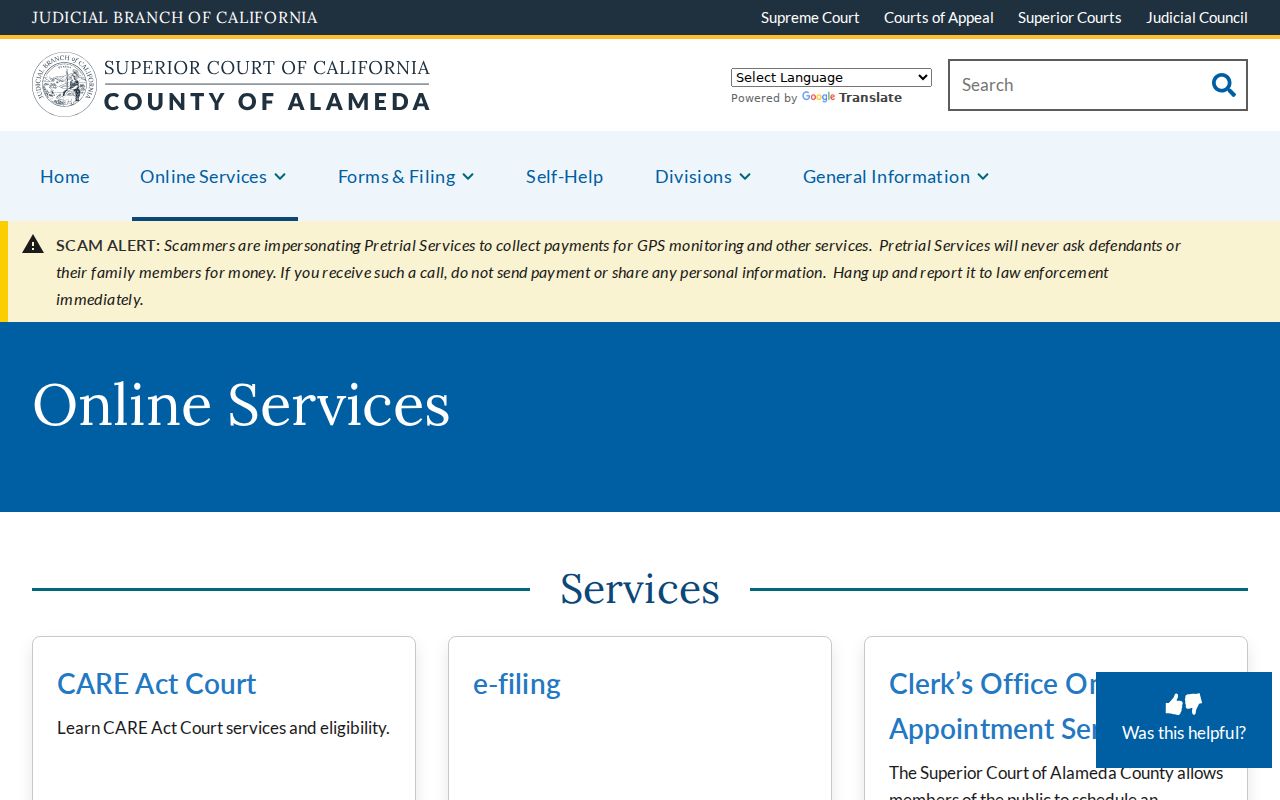
The court-service screen is a jurisdiction checkpoint. It can point a search toward the right case system, but a limited online index is not a complete Fremont resident record.
Fremont Residents Start with a Parcel
The most productive current-address trail begins with a physical parcel. The Alameda County Assessor Parcel Viewer accepts an APN, a site address, or a map selection. It can expose the parcel number, situs, assessed land and improvement values, assessment year, use description, tax-rate area, and map geometry. The property-tax route can add tax year, installments, payment status, and a mailing name or address where that information is public. None of those fields is a household list.
Fremont eGIS adds a city view of addresses, parcels, streets, zoning, land use, neighborhoods, and districts. Move from the address to the APN, then carry that key into the recorder and permit searches. An owner mailing address is a forwarding clue, not proof of residence. A local mailing address paired with an exemption may support an owner-occupancy inference, but it does not identify spouses, children, roommates, or other people associated with the property.
| Assessor control | Field type | What to enter or expect |
|---|---|---|
| APN | Text | One search route; use the displayed grouped digits and do not guess leading zeros. |
| Site Address | Text or autocomplete | Physical situs, not the owner's mailing address; start without a unit when needed. |
| Map | Interactive selection | Pan, zoom, and click a parcel when the address route is uncertain. |
| Search / Clear | Buttons | Run the query or reset the search fields. |
Use the Alameda County property-tax service as a second check, not as a substitute for the assessor map. Parcel geometry can reveal adjacent lots, while the recorded legal description controls the transfer history.
Fremont Deed Index Resident Trails
The Alameda County Official Public Records index is arranged around parties to recorded instruments, not around street addresses. Deeds, deeds of trust, reconveyances, liens, releases, judgments, easements, maps, and notices can create a trail. Search the current assessment name or a verified prior party, then compare the instrument type, recording date, legal description, subdivision, and cross-reference. A same-name hit without a parcel or legal-description match is only a lead.
The online name index covers 1969 to the present. Pre-1969 research moves to the Oakland office at 1106 Madison Street, where in-person work can reach the county's older records back to 1853. A Dublin satellite office is at 7600 Dublin Boulevard, Suite 160. Plain recorded copies are $3.50 per page; certification adds $1 to the first page, online orders carry a $2 convenience fee, and the stated mail turnaround is 5 to 10 business days. Mail requests need a filing number or other locator, payment, and a self-addressed envelope.
Index before copy. A copy order needs an instrument number, book and page, or reel and image. A street address alone is not enough to start the order.
In a backward chain, the current acquisition deed names a seller or grantor. Search that party as an earlier grantee, then repeat while checking the parcel's legal identity at each link. A trust deed secures financing, a reconveyance releases that security, and neither should be mistaken for the grant deed that transfers ownership.
- Roll
- An assessment or election list maintained for a defined purpose, not a complete list of all residents.
- Index
- A finding aid that points to a record; an index hit is not the same as the full document image.
- Criss-cross directory
- A reverse directory that starts with a street and number, then names the listed occupant or subscriber.
- Parcel
- A mapped unit of land identified by an APN and legal description, even when its mailing label changes.
Three Dates in the Fremont Residents Directory
Three dates keep a Fremont residents directory search from treating every record as if it came from the same system. Alameda County's record series begins in 1853. Fremont incorporated on January 23, 1956 by joining five communities, which marks the city's permit and administrative archive. The recorder's electronic official-record index begins in 1969, even though the county's older paper and image records reach much farther back.
- 1853 - Alameda County begins its own county record books after formation from parts of Contra Costa and Santa Clara Counties.
- 1956 - Fremont incorporates from Centerville, Niles, Irvington, Mission San Jose, and Warm Springs; most city permit records begin with the incorporation archive.
- 1969 - The Clerk-Recorder's electronic party index begins, while earlier official-record research remains an in-person task.
The 1868 Hayward earthquake damaged Mission San Jose and regional buildings, so mission and archival materials can matter where municipal record systems did not yet exist. The larger local lesson is about catalog language: searching only under Fremont can hide an older person or property filed under a predecessor community.
Note: The 1969 online cutoff describes the index, not the beginning of Alameda County's deed record series.
Current Fremont Resident Directories
Current directory work in Fremont is best understood as a set of narrow rolls and indexes. The Assessor can tie an address to a parcel. The recorder can show parties to a recorded instrument. City permit data can show an applicant, owner contact, project description, or inspection history. My Voter Status can confirm a person's own registration record. Public neighborhood or civic pages may expose officers and contact channels, but member rosters are ordinarily private.
| Source | What it can confirm | Keeper | Access reality |
|---|---|---|---|
| Parcel and assessment record | APN, situs, values, use, and possible mailing context | Alameda Assessor | Free APN, address, or map route |
| Official Public Records index | Recorded parties, document type, date, and transfer trail | Alameda Clerk-Recorder | Free electronic index from 1969; copies cost money |
| Citizen Access permit record | Address, project, applicant or owner contact where public, dates, and status | Fremont Community Development | Public search; city archive guidance begins in 1956 |
| My Voter Status | An authenticated voter's status, district, and election information | California Secretary of State | Self-authenticated; not public street browsing |
| Neighborhood or civic contact page | Public officers, events, and organization contact channels | City or organization | Public contact does not imply a member list |
These sources can corroborate a name, address, parcel, or organization, but they answer different questions. A person may have a business filing or professional license without living at the associated city or mailing address. A resident may have no property, permit, voter, or public organizational record at all. Careful directory work records what a source proves and what it leaves open.
Fremont Records from Incorporation Forward
Fremont Citizen Access is the city route for public permit and plan records. Choose Search Records, select a Building or related module, enter the street number and name, and set the Start Date to 01/01/1956 when looking for the full incorporated-city run. Available fields can include record type, record number, start and end dates, street number, street name, and parcel number. A result may show record number, description, status, applied and issued dates, inspections, public contacts, and selected document links.
Searching does not require an application account. Registered users can apply, pay, and schedule inspections. The Permit Self-Help Center at 39550 Liberty Street offers public computers; walk-ins are Monday through Thursday from 8:00 a.m. to 3:30 p.m. with a noon to 1:00 p.m. closure, and Friday from 8:00 a.m. to noon. Digital permit copies are free. Paper letter-size copies are typically $0.25 for the first five pages and $0.10 for each later page. Licensed-professional plans need written consent from the professional and current owner under Health and Safety Code section 19851.
AgencyCounter adds a map of active construction and development activity, daily summaries, and area email alerts. Permit evidence describes a physical project or a named applicant. It does not prove that the applicant lived at the address or that a later occupant was connected to the work.
The city's engineering channel can supply tract maps, parcel maps, aerial photographs, street-improvement plans, and construction drawings by phone or email. Engineering lists 510-494-4700 and engineering@fremont.gov. These materials can solve an address-continuity problem that a simple name search cannot.
Why Fremont Voter Records Stay Limited
California My Voter Status asks for first name, last name, date of birth, and the last four digits of a California driver license or identification card. The authenticated result can report registration status, party preference, county, districts, polling or vote-center information, ballot status, and voter-guide links. It can also show election participation history when released to an authorized user, but never a person's ballot choice.
That design matters for any Fremont resident directory search. Elections Code section 2194 permits voter-registration information for election, scholarly, journalistic, political, or governmental purposes determined by the Secretary of State, while commercial use is prohibited. Government Code section 7924.000 protects home street address, phone, email, prior registration information, identification numbers, and signatures from ordinary disclosure. A member of the public cannot use the self-service form to enumerate everyone on a Fremont street.
The Alameda County Registrar of Voters administers the county file and election work. Qualified requesters must use the current county or Secretary of State process, identify the requested geography and fields, state the permitted purpose, agree to the use restrictions, and follow the current fee or delivery rules. Safe at Home participants can register confidentially through the Secretary of State program.
The California My Voter Status form makes the authentication boundary visible.
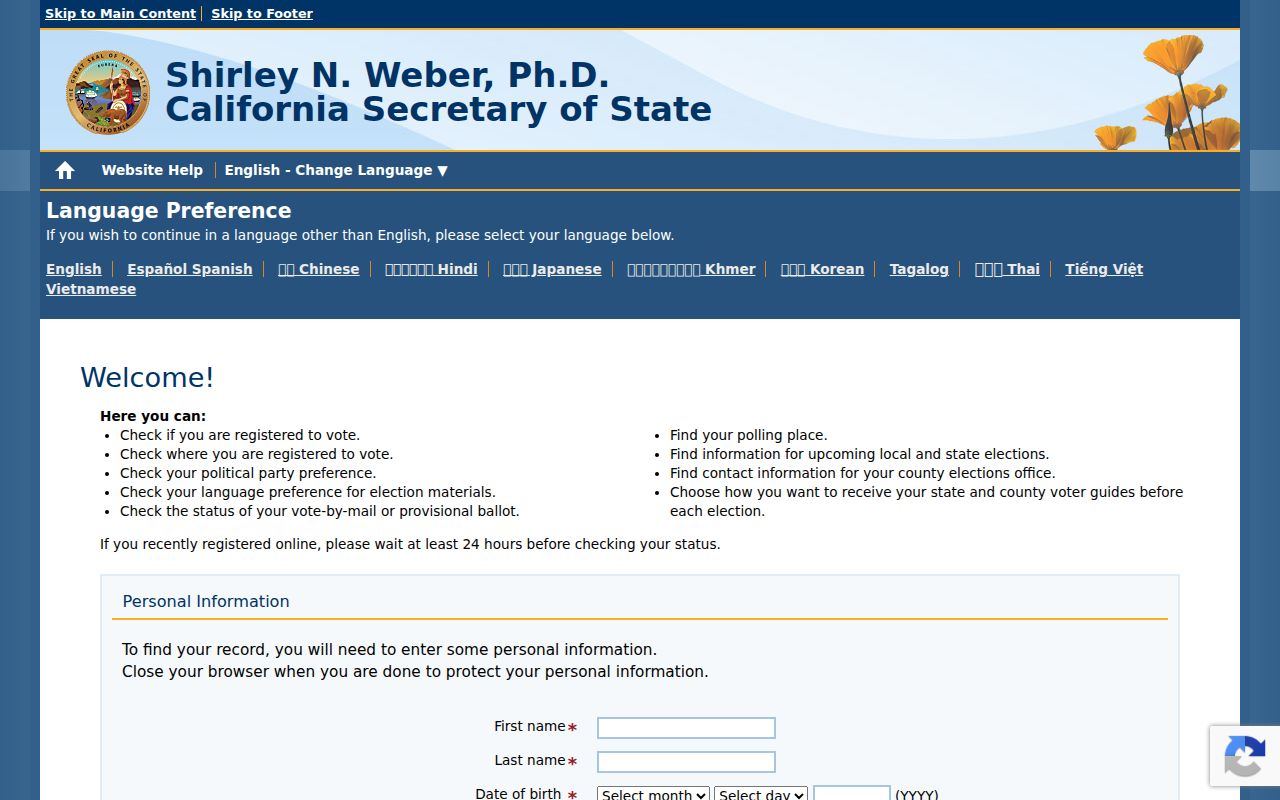
The form is useful when a voter is checking their own information. It should not be described as an open Fremont voter directory.
Note: An inactive or cancelled registration status is not proof that a person left a particular Fremont address on a particular date.
Fremont Resident Lookup Portals
A portal is valuable only when its search key matches the question. Address and APN work belongs with the Assessor and eGIS. Recorded ownership work belongs with the Clerk-Recorder's party index. City construction history belongs with Citizen Access and AgencyCounter. An authenticated registration question belongs with My Voter Status. A business affiliation can be checked in California bizfile, and a professional credential can be checked through the Department of Consumer Affairs. Court information follows the Alameda court systems rather than a city roster.
| Research path | Best evidence | Limit to keep in mind |
|---|---|---|
| Official parcel and deed records | APN, situs, recorded party, legal description, and transfer date | Owner or recorded party is not automatically an occupant. |
| City permits and maps | Project, address, applicant, inspection, parcel, and planning context | Applicant, owner contact, and resident can be different roles. |
| State identity and affiliation records | Authenticated voter status, business entity, or professional license | Affiliation or public city is not residence proof. |
| Commercial compilation services | Possible lead assembled from many data feeds | Paywalls, stale merges, and weak identity matches require official verification. |
California bizfile is a focused business-entity search, and the DCA search is a focused professional-license search. Each can corroborate a public affiliation when a name match needs another clue. These records establish an association with a business or credential, not a home address.
The California bizfile search is a useful example of a focused state lookup.
A business record can help separate two people with the same name when the entity, filing date, or agent relationship is independently tied to the right Fremont record.
Five Older Names in Fremont Directory Research
Fremont's five-town consolidation is the local story that changes how earlier residents are indexed. Before the 1956 incorporation, a household could appear under Centerville, Niles, Irvington, Mission San Jose, or Warm Springs. A modern Fremont street label may therefore be the wrong first term for an older directory, map, newspaper, or county record.
The five names are not just historical color. They point to different community trails: Niles carries rail and early film context; Mission San Jose leads toward Spanish, Mexican, and mission-era sources; Centerville, Irvington, and Warm Springs have their own school, agricultural, industrial, and civic records. The Fremont city directory collection workflow uses those predecessor names before trying a modern city label.
- Centerville
- Niles
- Irvington
- Mission San Jose
- Warm Springs
Address continuity also needs care. A rural route, street extension, subdivision, or changed number may preserve the parcel while changing the words printed in a directory. Tract maps, legal descriptions, APN ancestry, and the city's addressing function are stronger bridges than a guessed spelling.
Historical Fremont Resident Directories
Older Fremont residents directory research moves from current parcel evidence to the shelves and finding aids that preserve former households. Alameda County Library genealogy resources can lead to newspapers, licensed databases, and librarian help. Fremont Main's local and California history material, the Washington Township Museum of Local History, and archival finding aids can hold photographs, maps, clipping files, directories, and community publications that do not appear in a simple county name search.
Reverse or criss-cross directories are especially useful when the known clue is an address. Start with the predecessor town, locate the street section and house number, transcribe the listed occupant or phone entry, then check the alphabetical portion for a spouse, occupation, or abbreviation. Repeat neighboring editions and compare the result with deeds, permits, census material, or an obituary. A listed occupant is a period clue, not a guarantee of year-round residence.
The Alameda County Library genealogy desk provides a library route for databases and research help, while the Washington Township Museum of Local History supplies a location-specific historical route. Both are better starting points for older community names than assuming every record is filed under Fremont.
Note: A missing directory entry may reflect initials, spelling variants, a canvass gap, or a different predecessor-town label rather than a confirmed move.
Fremont Records When Online Search Stops
Online access is only one channel in the Fremont records chain. Pre-1969 recorder work requires the Oakland counter. The permit Self-Help Center offers public computers and staff guidance for the city's 1956-forward archive. Court records follow their own Alameda County custodian and access channels. Libraries and the Washington Township Museum can supply local-history material, while county and state archives may require a finding-aid or reference request.
- Write down the exact record type, address or party, date range, department, and known locator before contacting an office.
- Run the official online index or map, saving the APN, instrument number, record number, or case reference that appears.
- Use the counter, public terminal, phone, mail form, or library channel documented by the custodian when the online view is incomplete.
- Ask for an identifiable existing record, not a new list or a staff opinion about what a person did.
The county recorder accepts in-person research and mail copy requests. Fremont's City Clerk accepts online records requests. The city engineering channel can respond by phone or email for map and plan records. A focused request is often more useful than repeating a broad name search across unrelated systems.
Note: A counter, terminal, or archive can offer a wider lawful access route without making every record public or every field disclosable.
Fremont CPRA Requests for Identifiable Records
The California Public Records Act, Government Code sections 7920.000 through 7931.000, is the universal fallback when a Fremont agency holds an identifiable record that has no useful public search. Any person may request existing records, and a purpose statement is normally not required. A request should name the department, record type, address or project number, and date range. The agency does not have to answer a general question or create a new directory.
A CPRA request does not erase the distinction between public and protected information. Privacy limits, election-record restrictions, and California's address-confidentiality program still control what a custodian may release. A focused request for an existing Fremont record gives the agency a workable path while leaving confidential fields protected.
The current California Public Records Act text is the right source for the statute. Copy fees generally track direct duplication cost, while electronic delivery is normally not charged as a paper copy. A clear request that names the Fremont office and the existing record leaves less room for a wrong-office referral.
Private Fields in Fremont Resident Records
A Fremont residents directory cannot lawfully promise every name, address, or household detail. California voter records protect home street address, phone, email, prior registration data, identification numbers, and signatures outside approved uses. DMV personal data is restricted by the federal Driver's Privacy Protection Act. Utility, delivery, school-student, and ordinary household records are not open resident lists. Protected information can be unavailable even when a related public record exists.
California's Safe at Home program gives eligible participants a substitute mailing address and confidential mail forwarding, including a confidential voter-registration path. A protected address may therefore be absent or replaced by design. The same caution applies to an owner whose mailing address is elsewhere, a person connected to a trust or business, and a directory entry that has gone stale. Verification means returning to the custodian and respecting the record's stated access limit.
The California Department of Consumer Affairs license search can help distinguish names through a credential, board, city, or license status.
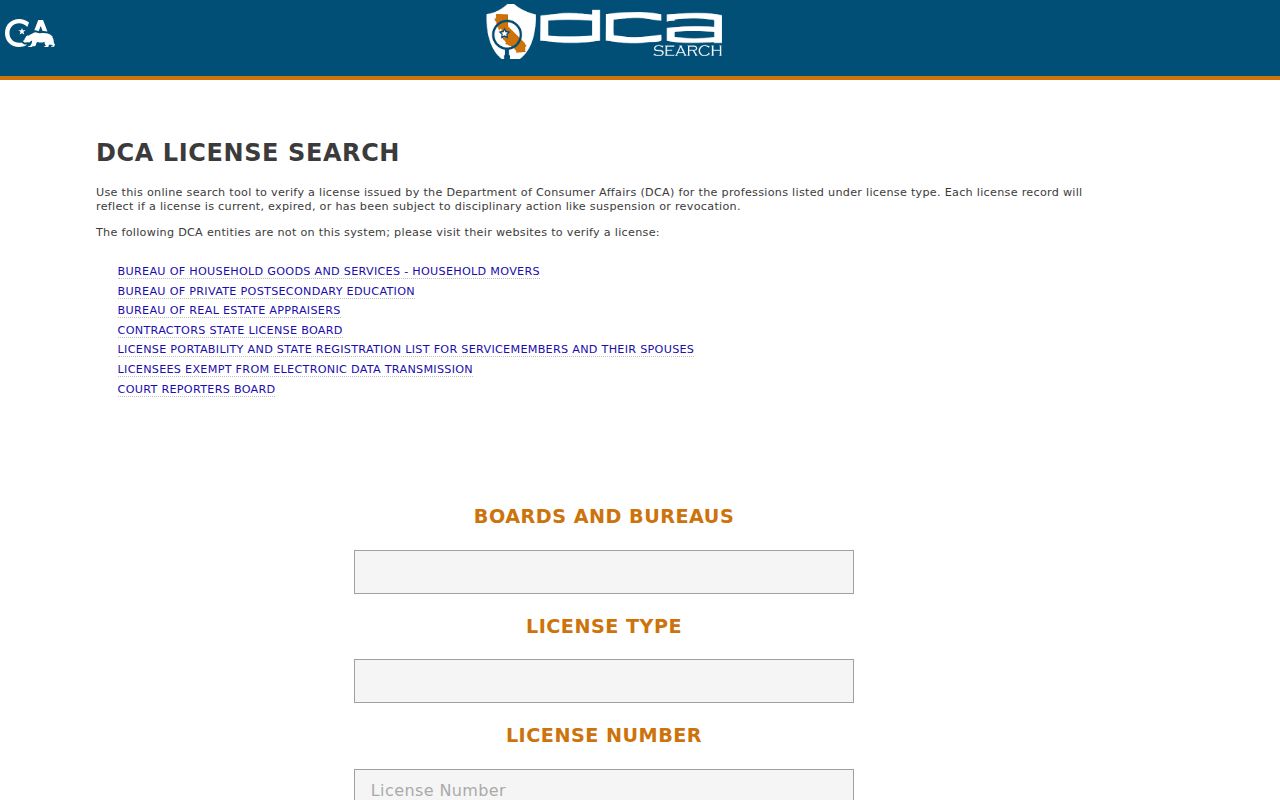
A license result may support an identity match or public affiliation. It does not establish that the licensee lives at a Fremont address.
Lawful personal use. Fremont public records can support family history, reconnecting, property curiosity, and civic research. Do not use a record to stalk, harass, intimidate, or harm another person.
Note: The absence of a public hit is not evidence that a person is absent from Fremont; it may show only that the record is protected, private, or held elsewhere.