
Fremont Previous Residents by Era
A Fremont house history needs two tracks. A recorded instrument can show a named party and legal transfer, while a directory or census can place a household at a dated address. Permits date physical work, not a move. Newspapers, mission registers, and probate can explain death, inheritance, or a household change after the main trail thins.
| Record source | Coverage | Keeper or route | Clues it offers |
|---|---|---|---|
| Alameda recorded instruments | 1853 to present; electronic party index from 1969 | Clerk-Recorder online or Oakland counter | Deeds, liens, maps, and the legal-name chain |
| Fremont permit archive | 1956 to present retention statement | Citizen Access or Self-Help Center | Projects, applicants, owners, inspections, and dates |
| Fremont and Washington Township directories | Scattered late-19th and 20th century editions | Fremont Main or Museum of Local History | Name-to-address and reverse street occupants |
| Federal census schedules | 1850 to 1950 public; 1960 scheduled for 2032 | NARA and library databases | Household members, relationships, age, and address sequence |
| Sanborn fire-insurance sheets | Limited and scattered local coverage | Library of Congress or UC Berkeley collections | Footprint, street number, materials, and historic use |
| Newspapers and obituaries | Title-dependent historic and modern runs | Library and newspaper archives | Moves, kin, deaths, organizations, and estate clues |
| Mission San Jose registers | Mission era forward, series-specific | Diocese, FamilySearch, or archival finding aids | Baptisms, marriages, burials, and kinship |
Choose the source by era. A recent address usually begins with the parcel, deed index, and permit trail. An older household may need a predecessor town name, reverse directory, census district, or mission register before a modern Fremont label makes sense. The Fremont city directory collections explain the volumes and reading conventions; deed and permit work keep the address fixed.
Fremont Previous Residents: Three Record Dates
Three dates set the pace for previous-resident research in Fremont. Alameda County's record series begins in 1853, while older land and mission material may belong to predecessor county, state, or church collections. Fremont incorporated on January 23, 1956 by joining five communities, and the city says most permit records exist from incorporation. The electronic official-record index begins in 1969. These dates mark changes in custodian and access, not a sudden change in who lived on a parcel.
| Date | Fremont milestone | Search effect |
|---|---|---|
| 1853 | Alameda County was created from parts of Contra Costa and Santa Clara Counties | County deed and related record books begin, with earlier material in predecessor or archival series |
| 1956 | Fremont incorporated through the consolidation of five communities | City permit retention begins at incorporation; older entries use local town and Washington Township labels |
| 1969 | Clerk-Recorder electronic official-record index begins | Online party-name searching starts here; older deed research moves to the Oakland office |
Oakland is the Alameda County seat and remains the place for pre-1969 recorder index work. Stopping at the first online result can make a long-lived address look new. A current-name search can miss the parcel under Centerville, Niles, Irvington, Mission San Jose, or Warm Springs. Treat the dates as route markers, then let the parcel and legal description decide the next step.
Fremont Address History Starts at an APN
An address is useful, but the stable key in a Fremont house history is often the parcel. The Alameda County Assessor's parcel viewer accepts an APN, site address, or selected parcel. The APN is the assessment key; the situs is the physical land; the mailing address is where notices go; the legal description identifies the land in a deed.
Search the site address, leaving out a unit when a multiunit result needs the larger parcel. Record the APN, lot clues, assessment year, use, and public mailing information, then carry them into the recorder search. That parcel anchor keeps the previous residents trail tied to one piece of land even when a street name changes. Matching mailing and situs addresses may support an owner-occupancy inference, but they do not identify other household members. A different mailing address keeps ownership and occupancy in separate columns.
Address trail: situs address → APN → parcel details → recorded instrument → prior grantor → directory, census, or probate evidence.
Alameda Deed Chain for Fremont Previous Residents
The Alameda County Clerk-Recorder's Official Public Records index is arranged around parties named in instruments, not streets. Start with the current parcel. Once the APN and legal description are known, the acquisition deed can identify the seller. Search that seller as the next grantee instead of guessing from a surname.
- Open the parcel record and note APN, site address, legal description, and any assessment or mailing clue.
- Choose individual or business in the recorder index. Narrow a name with first name, dates, and document type when needed.
- Read the instrument number, date, type, book/page or reel/image, parties, and legal description. A party hit proves recording, not occupancy.
- Search the seller or grantor as a grantee in an earlier range. Match lot, block, subdivision, APN references, and trust names.
- At 1969, move to the grantor-grantee books and indexes at 1106 Madison Street in Oakland. County records reach back to 1853.
- Grantor and grantee
- The grantor transfers or releases an interest; the grantee receives the named interest.
- Chain of title
- Linked recorded transfers used to follow one parcel through earlier owners.
- Legal description
- Deed wording, such as lot and block, that can outlast a street label.
- Criss-cross directory
- A reverse directory arranged by street and number to find a listed occupant.
- Enumeration district
- A census area whose street sequence can bridge an address when name indexing fails.
Fremont Deed Index Copy Details
An index entry is a lead, not the full instrument. The Alameda County recorded-document copy order shows the fields needed to request a copy. An instrument number is best; book/page or reel/image can serve when it is missing. Compare names, dates, and parcel language before treating a copy as part of a Fremont previous-resident trail.
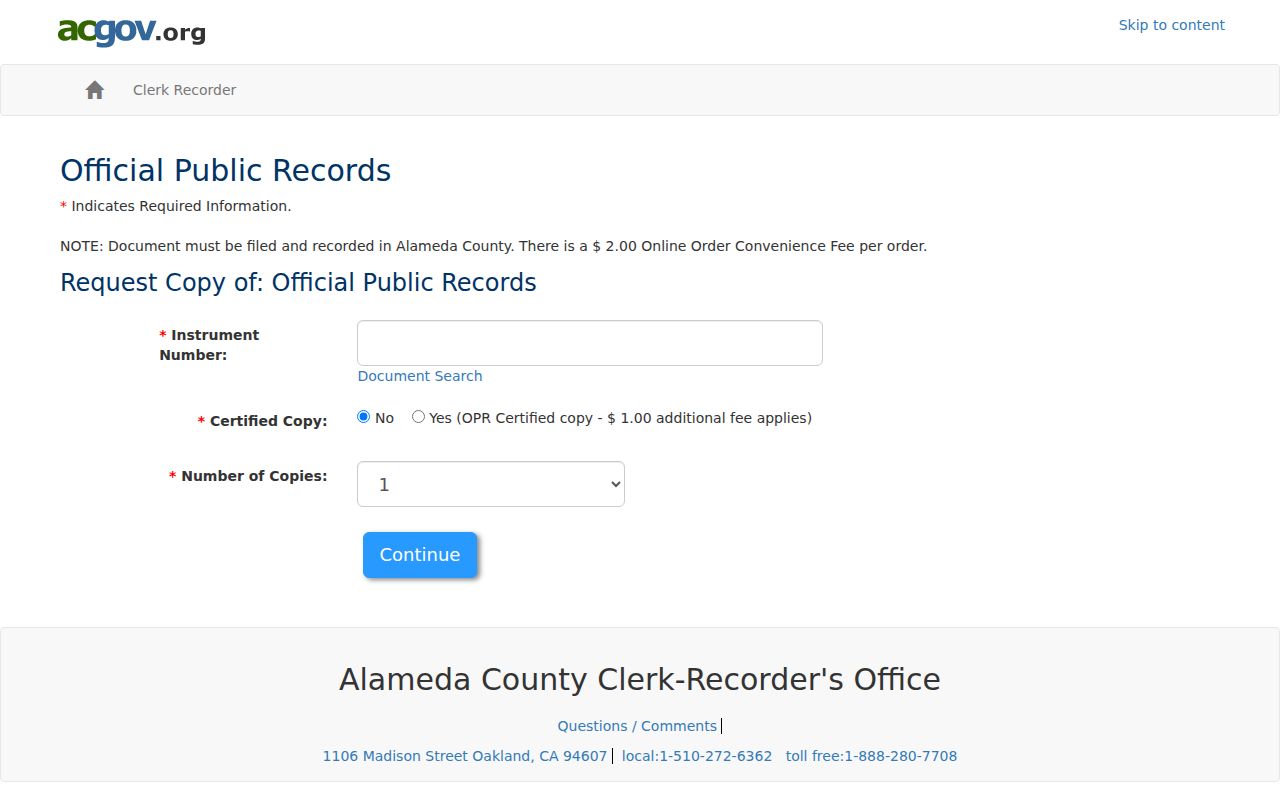
Plain recorded documents are listed at $3.50 per page. A certified copy adds $1, making the first page $4.50 and later pages $3.50. An online order carries a $2 convenience fee. Mail requests use a check or money order and a self-addressed stamped envelope, with a stated 5 to 10 business day turnaround. Credit cards are for online orders only. The image ties the instructions to the source route.
A useful index result may include:
- Party names and the role inferred from the instrument, such as grantor, grantee, debtor, or beneficiary.
- Instrument or document number, recording date, document type, and page count.
- Book/page or reel/image information for older entries and any indexed cross-reference.
- Legal-description language that helps confirm the parcel beyond a matching name.
- Redactions or access limits that keep sensitive numbers out of a public image.
Fremont Permit Trail after 1956
Fremont's permit archive adds physical history after incorporation. The public Citizen Access search can be searched by record, address, and date. City guidance says to use a start date of 01/01/1956 for the full incorporated-city run. An account is needed for applications, alerts, and some documents. A focused Fremont records request is the fallback when a visible result is not enough.
Permit evidence can date construction, additions, demolition, inspections, and other work. It may show an applicant, owner, or contractor, but none of those roles proves residence. City permits do not fill a pre-1956 gap; earlier research belongs with Alameda County sources, predecessor town records, directories, and archives.
A permit search may return:
- Record number, record type, site address, and parcel or project reference.
- Applicant, owner, or contractor names when the public record displays them.
- Work description, filing date, issue date, status, and inspection milestones.
- Public document links, with plan or personal details withheld when required.
Five Fremont Town Names before 1956
Fremont previous residents often appear under a town name that predates Fremont. The 1956 incorporation joined Centerville, Niles, Irvington, Mission San Jose, and Warm Springs. These names are catalog terms that can control where a directory, newspaper, family file, or mission record is shelved. Newark and broader Alameda County titles may also enter the search.
The Washington Township Museum of Local History is the most location-specific contact for photographs, clipping files, directories, school and community publications, and oral histories. Fremont Main can supply shelf-level help. The Online Archive of California can surface Washington Township material held by the museum, Bancroft Library, or another repository. Search each older community before calling a missing entry proof of absence.
Note: A missing Fremont entry may reflect an old community label, a canvass gap, or a spelling variant rather than a confirmed move.
Fremont Directories and Census Households
Directories and census schedules move the search from a recorded owner to past residents listed at an address. An alphabetical entry may carry a name, spouse notation, address, or roomer marker. A reverse section sorts by street and number. The 1950 census is the newest public population schedule as of 2026; it shows a dated household snapshot, not continuous residence.
NARA's census guidance explains the 72-year release rule. Pairing a directory with the nearest census tests a lead without assuming that matching names are the same person. Enumeration districts help when name indexes miss a street.
- Identify the historical community and street wording before opening a volume.
- Read the directory's front-matter abbreviation key, then check the alphabetical entry and its address.
- Use the reverse or criss-cross section to inspect the same number and nearby numbers on the street.
- Repeat in adjacent editions to find first and last appearances, then compare with the closest census schedule.
- For years after 1956, compare the household clue with permits and recorded instruments, keeping occupancy separate from title.
Bridge Old Fremont Address Names
Address continuity can fail when a road gains a suffix, a rural route becomes a numbered street, a street extends through a tract, or a parcel uses a predecessor town. No authoritative citywide list of every Fremont change with effective years was located, so a specific change needs a custodian record. The safer bridge is APN ancestry, a tract reference, legal description, and old community name.
Fremont's GIS and addressing division handles address verification and proposed street names. County recorder and engineering maps connect lot and block language to a modern parcel. Sanborn sheets can add a historic footprint or number. Search several old forms, then require two independent clues before linking a record to a present parcel. Fremont Engineering's research contact is 510-494-4700 or engineering@fremont.gov.
Past Fremont Households in Directories
Previous residents are best described as dated evidence, not one final list. A previous residents entry should state its year, source, and address clue. A reverse directory can place a listed occupant beside nearby numbers. A census shows household composition on its date. An obituary can name kin, an earlier residence, service, or cemetery. Probate, a final distribution, or a later deed can explain an inheritance. Mission San Jose registers and cemetery files add older kinship clues, but access varies.
Use the Alameda County Library genealogy resources for newspaper, obituary, census, and family-history leads, then corroborate a notice with a death index, probate record, or transfer. An heir's service address is historical evidence, not a current-residence guarantee. A directory omission may reflect a canvass gap, limited delivery, initials, or a misspelling.
| Evidence | Strongest claim | What it cannot prove alone |
|---|---|---|
| Recorded deed or instrument | A named party and a legal transfer or recorded interest | That the party lived at the situs |
| Directory or census entry | A listed household or occupant at a dated address | Continuous residence outside the edition or census date |
| Obituary or probate file | Death, kinship, estate, and a possible prior address | A present address for a living relative |
Lawful use. Previous-resident research in Fremont is suited to house history, genealogy, estate work, and personal curiosity. Using records to watch, harass, threaten, or harm a living person can violate California law, including Penal Code section 646.9 and Code of Civil Procedure section 527.6.